
At a Glance
- Company: Global home appliances leader
- Scale: 10,000+ field engineers and business stakeholders
- Project: Mission-critical Android field application modernization
- The Shift: Java & XML Android monolith -> Flutter, Dart, MVVM, Riverpod, GoRouter, and Drift
- The Impact: 611,374 lines reduced to 208,859 lines, with zero critical crashes across core workflows
Executive Summary
For a global home appliances leader, a mission-critical field application had become a daily drag on field operations. More than 10,000 engineers and stakeholders depended on the app, but the Android-only codebase was fragile, difficult to extend, and burdened by nearly a decade of technical debt.
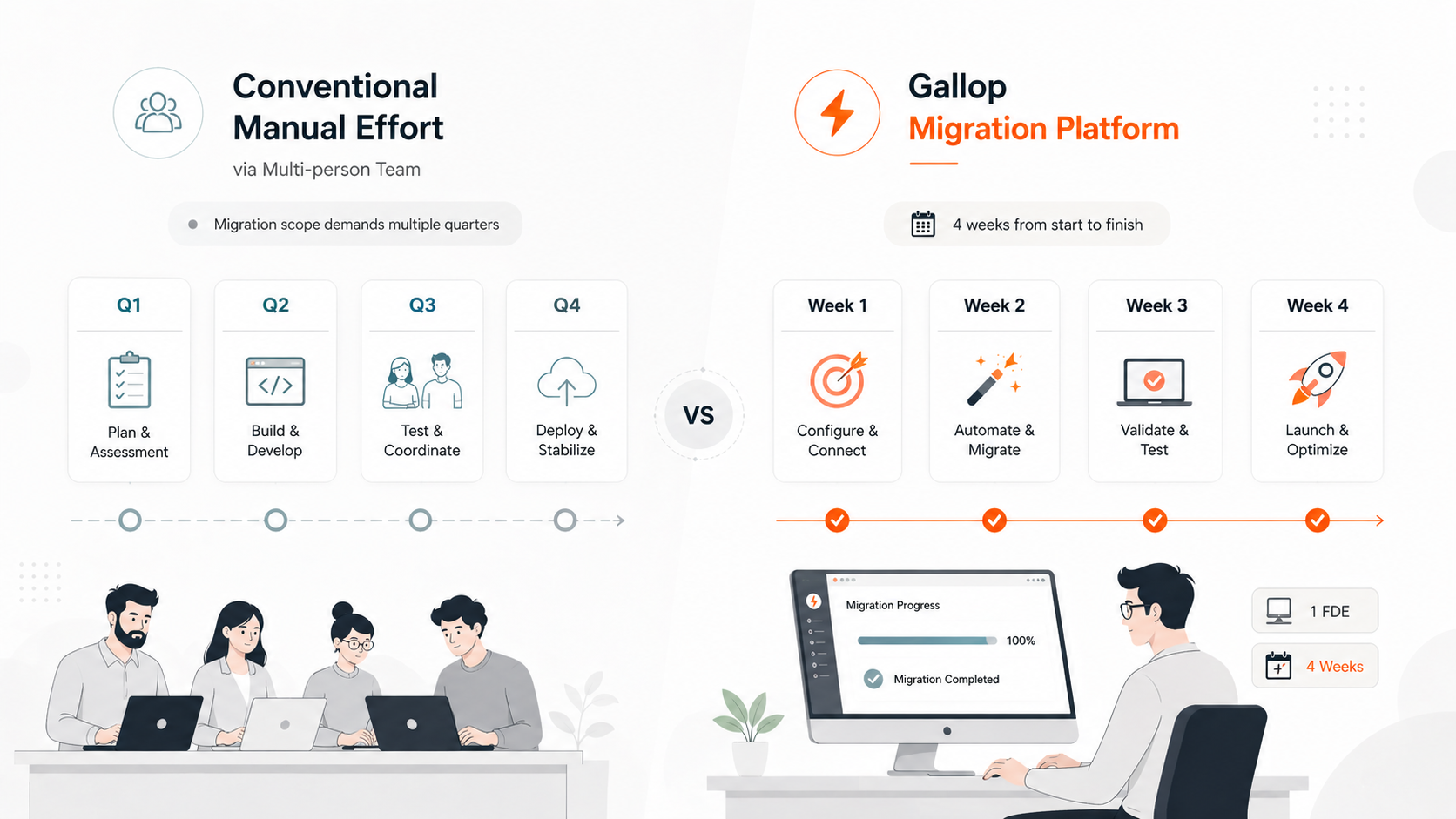
Using Gallop's AI-driven Modernization Platform, the application was rebuilt in Flutter in 4 weeks by a single Forward Deployed Engineer. The engagement reduced the codebase by 65%, eliminated critical crash paths, introduced a modern automated test foundation, and gave the product team a platform they could evolve beyond Android.
The Challenge: A Field App Holding Back Operations
The legacy application still supported essential daily workflows, but its architecture had become a liability. Years of patches across Java, XML layouts, and aging Android patterns made even small changes risky.
The team faced five core problems:
- Platform Lock-In: The app ran only on Android, creating a hard ceiling for future iOS, web, and desktop expansion.
- Crash-Prone Workflows: Dashboard drill-downs, assignments, notifications, and form submissions failed in production-critical paths.
- Fragmented User Experience: More than 300 activities and fragments, 345+ XML layouts, and dialog-heavy flows made common tasks feel slow and inconsistent.
- Hidden Business Intelligence: The backend exposed valuable operational data that the legacy client never surfaced clearly to users.
- Minimal Test Coverage: Releases depended heavily on manual QA, slowing delivery and increasing regression risk.
The Approach: A Controlled Flutter Modernization
Rather than patching the Android monolith or starting a conventional multi-quarter rewrite, the client used Gallop to execute a focused modernization across four workstreams:
- AI-Assisted Discovery: Gallop analyzed the Java/XML codebase, mapped routes, screens, dependencies, and failure-prone workflows, and established the baseline for what had to be preserved.
- Architecture Planning: The target application was designed around Flutter, Dart, MVVM, Riverpod, GoRouter, and Drift, giving the team a modular foundation with clean separation between presentation, state, navigation, and storage.
- AI-Assisted Execution: Gallop accelerated the migration of screens, workflows, and business logic while the Forward Deployed Engineer focused on review, architecture, and production-readiness.
- Reliability Validation: Critical user journeys were rebuilt with automated tests, widget tests, golden coverage, and integration suites to ensure the new app could move faster without reintroducing legacy risk.
Business Impact: Smaller, Safer, and Ready to Scale
The modernization changed the application from a fragile Android asset into a durable cross-platform foundation:
- 65% Smaller Codebase: The application moved from 611,374 lines to 208,859 lines, eliminating years of redundant Java and XML overhead.
- Zero Critical Crashes: Historical crash paths across dashboard, assignment, notification, and form workflows were eliminated.
- Cross-Platform Readiness: The new Flutter codebase supports Android and iOS from one foundation, with a path toward future web and desktop expansion.
- Modern Test Coverage: The rebuilt app includes 240+ automated test files and 10+ integration suites, reducing dependence on slow manual QA cycles.
- Faster Product Velocity: Modular MVVM architecture, centralized widgets, and clean state management allow the team to ship changes without touching the entire system.
What Changed in the Product
The migration was not a one-to-one port. The team used the modernization to remove structural friction from daily workflows:
- Dialog-heavy drill-downs became fluid, tabbed interfaces.
- Dashboard filters now persist through the active session.
- Form submissions gained loading guards and ViewModel debouncing to prevent duplicate writes.
- Offline states are handled gracefully instead of failing without context.
- Shared widgets replaced hundreds of fragmented XML definitions.
Outcome
In 4 weeks, Gallop helped the client turn a brittle field app into a cleaner, tested, cross-platform product foundation. The result was not just fewer crashes or fewer lines of code. It gave the engineering team a system they could understand, validate, and extend with confidence.
The Gallop Modernization Platform did not just migrate an app.
It gave a product team back its ability to move.